Vibe Coding Development Services: A €3,000 and a €12,000 Quote Can Buy the Same Screens
The screens in an agency quote are what your AI tool already builds. Compare vibe coding quotes on the five lines a prototype leaves out: data locked to each user, a security review, deployment, code ownership and fixes after handoff.
In May 2025, a security researcher took the authorization header out of a request a paid Lovable site was already sending. That header tells the server who is asking. Without it, he wrote a new record straight into the database.
The record said it was paid. Stripe never saw it. Matt Palmer's disclosure shows the row, trimmed:
{
  "linkedin_url": "https://www.linkedin.com/in/matt-palmer/",
  "payment_status": "paid",
  "website_url": "https://mattpalmer.io",
  "created_at": "2025-05-25T10:03:33.87533+00:00"
}
Every screen on that site worked. The flaw sat in the database behind it.
Picture a prototype like that, and two quotes to finish it. One costs several times the other.
Vibe coding development services are agencies and freelancers who build or finish apps with AI coding tools such as Cursor, Claude Code and Lovable. Published 2026 prices run from $500 for a freelance prototype on Upwork and €2,000 at agencies to $15,000 to $80,000 for a production build. Most of the gap is the work after the prototype.
So compare quotes on the five lines your prototype leaves out:
- who proves each user's data is locked to that user
- who reviews security
- how the app gets deployed
- who owns the code
- what gets fixed after handoff
Your AI tool already builds the screens. A quote that prices screens and skips those five lines is selling you a second prototype.
What do vibe coding agencies charge in 2026?
The published prices spread wide. The spread has a pattern.
When one seller lists two steps, the more expensive step adds auth, payments, tests, deployment or support. Screens are rarely the main addition.
Table: What the next price step adds, from sellers' own pages
| Seller (date) | Cheaper step | What the next step adds |
|---|---|---|
| Eplanet Soft (2026-11-13) | Proof of concept from $3,000: one user flow, clickable prototype, basic auth, deployment included | Full MVP from $8,000: payments, full backend, CI/CD pipeline, 30 days of support |
| Gemeos (2026-08-07) | Prototype €2,000 to €5,000: core user flow, demo | MVP €5,000 to €15,000: backend, authentication, deployment |
| Upwork (Nov 2026) | Basic prototype $500 to $2,000 | Standard app $2,000 to $8,000: more features, API integrations and testing |
| Afterbuild Labs (2026-11-04) | $299: one critical bug fixed | $1,999: a deploy-to-production pass |
Most of what each step adds is work a prototype skips: auth, payments, tests, deployment and support. Eplanet's cheaper step already includes deployment. CI/CD is an automated pipeline that tests and deploys each change.
The agency Gemeos puts the point plainly: "A €3,000 MVP and a €12,000 MVP do not necessarily correspond to the same deliverable." Its checklist for reading a quote names design, backend, authentication, testing, deployment, source code, documentation and post-delivery bug fixes.
That checklist comes from a seller. So does every other price on this page.
No independent survey of vibe coding agency prices turned up in research for this article. All three comparison lists cited here, from Gemeos, Groovy Web and DesignMe, rank their own publisher first. That limit is the reason to compare what each price includes, instead of asking which total is fair. You can check inclusions on the sellers' own pages.
Location explains part of the spread too. Groovy Web puts US boutique vibe coding shops at $150 to $300 an hour and offshore AI-first agencies at $22 to $50.
Location sets the price of an hour. The rate says nothing about what the agency spends those hours on. Inside one seller's list, location stays fixed, yet the price still rises from step to step. So the rise comes from what each step adds.
Why the missing lines are the ones that leak
The paid site in the opening kept its data in Supabase, the hosted database behind Lovable apps, which the browser talks to directly.
Row-level security is a rule inside the database saying which rows each user may see or change. The page carries a public key. Row-level security decides what that key can read. Supabase's documentation is blunt about the default: "A table in an exposed schema without RLS is readable and writable by any role with a grant on it."
Any role includes the signed-out visitor holding the public key. Removing the header worked because the database had no rule stopping a signed-out request.
A prototype can run for months with those rules missing, because the person testing it is the only user.
In March 2025, Palmer scanned 1,645 Lovable projects and found 303 endpoints across 170 projects with inadequate rules. That was homepages alone.
Palmer works in developer relations at Replit, a competitor, so weigh the framing. Still, his findings became CVE-2025-48757, a public ID for a known vulnerability.
A broader scan by the security firm Escape covered over 5,600 public vibe-coded apps, though its report page says 1,400. It counted more than 2,000 vulnerabilities and over 400 exposed secrets. Anyone could reach most of them without logging in.
So the line a prototype skips first, data locked to each user, is the one that leaks.
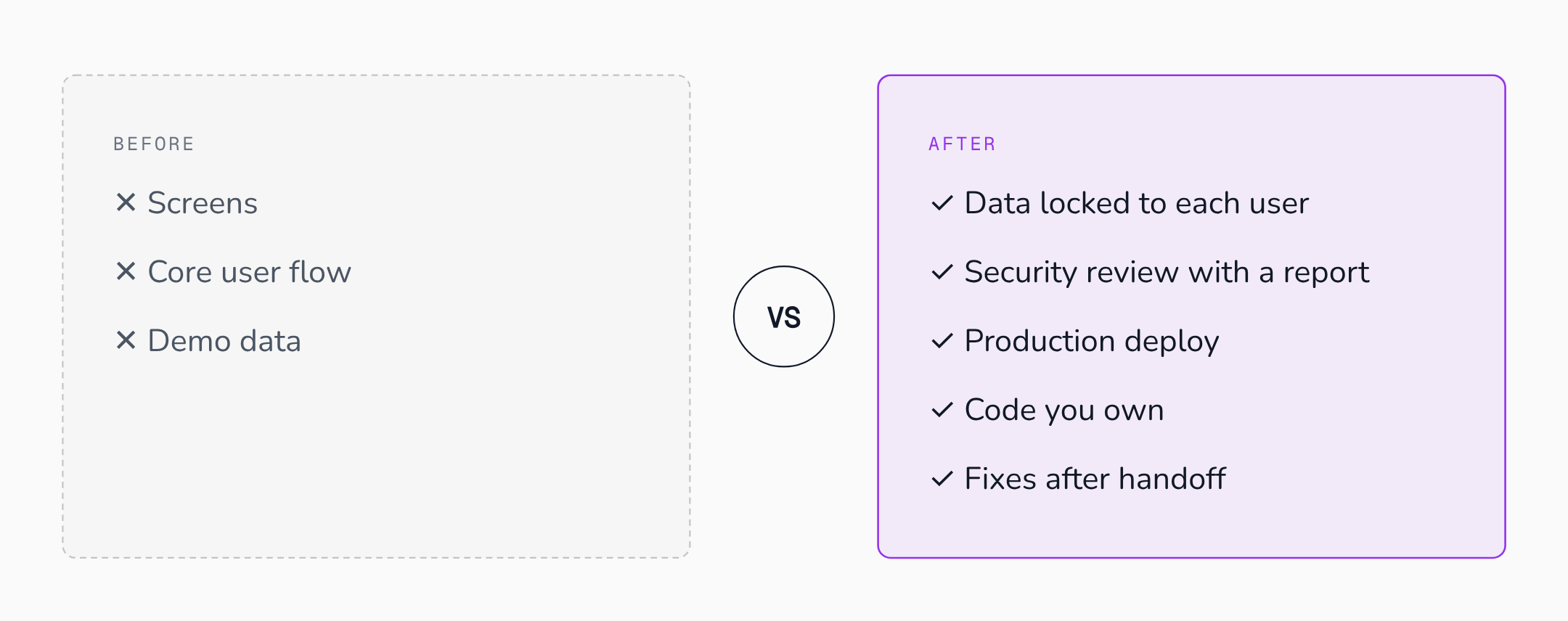 The left side is what an AI app builder already gives you, so a quote should charge little for it; the right side is what the price difference between quotes should buy.
Doesn't the builder's security scan already cover this?
Partly. That partial cover is the strongest case against paying an agency.
Lovable now runs a Quick scan every time you open the publish dialog, checking for tables without row-level security, access rules that let everyone through, and vulnerable dependencies. A Deep scan reviews the app's own logic and permissions. Whether you can publish with open findings depends on your workspace's publishing controls. In May 2025 the scanner checked only whether a row-level security rule existed, not whether the rule was right, Palmer wrote.
A scan finds problems. Someone still has to judge each finding and fix it.
In February 2026, The Register reported on an exam-and-grades app featured on Lovable's own showcase that exposed 18,697 user records, including 4,538 student accounts. The researcher, Taimur Khan, said its AI-written access check had the logic backwards. It blocked signed-in users and let signed-out ones through.
Lovable answered: "This project also includes code not generated by Lovable and the vulnerable database is not hosted by Lovable."
Lovable's CISO, Igor Andriushchenko, told The Register every project gets a free scan before publishing. He added: "Ultimately, it is at the discretion of the user to implement these recommendations. In this case, that implementation did not happen."
A clean scan today still leaves the data line unproven.
A scan flags patterns. Only you know which user should see which row. So only a test written against your app's own rules proves them: the allow-and-deny test in the five lines below.
If you can read a finding, fix it and run that test, you do not need an agency for that line. If you cannot, pay for that line.
Skipping that line costs money too. Justin McKelvey sells fixed-price rescues of AI-built apps and lists invoices from his own work, including $8,000 for a Replit app where any logged-in user could read any customer's data across 47 endpoints.
McKelvey's summary of what a build without a developer's review lacks: "You're buying typing without judgment."
Five lines to compare on every quote
Ask every seller the same five questions, in writing, before you look at the totals.
Data locked to each user. Ask how they will prove that a signed-out visitor, and a second signed-in user, cannot read or change your users' rows. A good seller answers with a test.
Supabase's own guide asks for a test file that asserts allow and deny for select, insert, update and delete, for both the anonymous and the signed-in role. The file runs with supabase test db.
A seller who cannot describe that check has not priced it.
A security review with a written report. Ask who reviews the code and what you receive.
Sellers also price reviews on their own. That gives you a yardstick. A comparison read on 8 November 2026 lists fixed audit prices of $499, $1,000 and $1,500. One firm, Wavect, charges €750 for a test pass plus €150 per accepted finding, capped at €1,500 for up to five findings. McKelvey, who sells rescues, puts a pre-launch security review at $2,000 to $10,000.
A quick audit and a full review sit thousands apart. Ask which one the quote prices.
Deployment that survives leaving preview. The preview is the builder's test copy of your app. Ask where the live app will run and who moves the settings across.
Afterbuild Labs says most broken Lovable deploys it sees fail on one of these:
- missing environment variables, the secret settings such as API keys that the preview set for you
- row-level security still off
- Google sign-in redirects still pointing at
localhost:3000, a developer's own machine, instead of the live site
Payment webhooks belong here too. Stripe webhooks are the messages Stripe sends your server when a payment succeeds or fails. One of McKelvey's invoices was $15,000, for a client whose unverified webhooks silently dropped about 15% of more than $200,000 in payments.
Webhooks fail in two ways. Anyone can fake an unverified one. Checking Stripe's signature stops that. Payments also go missing when the app handles only the completed checkout. Afterbuild Labs' checklist asks for the other events to be handled too, such as failed payments and cancelled subscriptions. Ask who verifies the webhooks, and which events beyond a completed checkout get handled.
Code you own. Ask whose GitHub account holds the repository and when ownership passes to you. Do not assume it does.
The DesignMe comparison covers ten rescue firms. Four did not say on their own pages who owns the code when the work ends, and a fifth hands over code with tests and CI without stating ownership.
Fixes after handoff. Ask how long bugs are fixed for free and what counts as a bug. Published terms run from 30 days of priority support to two weeks on call, and Upwork lists ongoing development and maintenance at $3,000 to $10,000 a month.
A quote with no line for this ends the day the app goes live, which is the day real users start finding what the demo never touched.
What to keep doing yourself
The five lines also tell you what not to buy. Your AI tool does good work on screens, copy, layout and a low-risk flow you could throw away. An agency hour spent on them buys little.
Mia Kotalik, a freelance engineer, was cleaning up an AI-built prototype when KUOW interviewed her. She drew the same line.
"I wouldn't tell them don't use AI tools or try and make a prototype yourself ... But I wouldn't make any of those decisions without consulting somebody who has that technical background," she said.
You can start on the first line, data locked to each user, before anyone quotes. Build to Launch's eight vibe coding mistakes that break production says to open the database before you ship. Check that passwords are hashed, never stored as plain text. Check that API keys are not hardcoded. Check for browser calls that belong on the server.
Then test the lock itself.
Afterbuild Labs' checklist says the public key must not read rows for a signed-out user. Open the app in an incognito window and try.
Next, sign in as a second test user and try to open the first user's records. Recall McKelvey's $8,000 case. Any logged-in user could read any customer's data. That leak ran between signed-in accounts. An incognito check never tries that.
Build to Launch's Everything Vibe Coding hub collects more self-checks like it.
Whatever you can verify, keep.
Spend the money on the lines you cannot verify, starting with a test that proves neither a signed-out visitor nor a second user can read your users' rows.
FAQ
Should I fix my vibe-coded app or rebuild it?
Most of the ten teams in the DesignMe comparison sell an audit before the fix. Several give a call for each part. Wavect will "keep, improve or replace", and Cleveroad gives a keep-or-rebuild verdict. The two paths are priced far apart.
McKelvey puts targeted fixes at $3,500 to $15,000 and full rescues at $25,000 to $50,000.
Ask for the audit's keep, fix or rebuild call in writing before you agree to a rebuild.
How much does a security audit of a vibe-coded app cost on its own?
Fixed audit prices read on sellers' own pages in November 2026 ran from $49 for Afterbuild Labs' async audit to $1,500. The DesignMe comparison, read on 8 November 2026, lists fixed audits from $499. Two firms there, MetaCTO and Pfaff Digital, offer a free first assessment, though MetaCTO lists its rescues at $50,000 to $150,000.
A full pre-launch review costs more. McKelvey prices one at $2,000 to $10,000.
An audit tells you what is wrong. Sellers quote the fixes separately.
Who owns the code when an agency finishes my app?
The contract decides.
Lovable states that you own the code you build on its platform. An agency working in its own repository is a separate agreement, and several rescue firms do not publish their terms.
Get the repository in your own GitHub account, or a dated transfer clause, before work starts.
Sources
- Statement on CVE-2025-48757, Matt Palmer, 2025-05-29
- Top 10 best vibe coding agencies in 2026, Gemeos, 2026-08-07
- Vibe Coding & MVP Development, Eplanet Soft, read 2026-11-13
- Best Freelance Lovable Developers for Hire, Upwork, November 2026
- Hire a Lovable Developer, Afterbuild Labs, figures checked 2026-11-04
- Top 10 Vibe Coding Agencies for Startups 2026, Groovy Web, 2026-05-12
- Row Level Security, Supabase Docs
- Methodology: 2k+ vulnerabilities in vibe-coded apps, Escape, October 2025
- The State of Security of Vibe Coded Apps, Escape
- Security overview, Lovable Documentation
- Lovable-hosted app littered with basic flaws exposed 18K users, The Register, 2026-02-27
- How Much Does Vibe Coding Cost? Real 2026 Numbers, Justin McKelvey, reviewed August 2026
- Best agencies to fix a vibe-coded MVP (2026), DesignMe, prices read 2026-11-08
- The human coders hired to mop up AI slop, KUOW, 2025-10-01
- Lovable Pricing, Lovable
- 8 Vibe Coding Mistakes That Break Apps After You Ship, Build to Launch, 2025-12-31
- Everything Vibe Coding: From First Prompt to Production App, Build to Launch
Links
- Statement on CVE-2025-48757 (Matt Palmer) (documentation)
- Top 10 best vibe coding agencies in 2026 (Gemeos) (documentation)
- Vibe Coding & MVP Development (Eplanet Soft) (documentation)
- Best Freelance Lovable Developers for Hire (Upwork) (documentation)
- Hire a Lovable Developer (Afterbuild Labs) (documentation)
- Top 10 Vibe Coding Agencies for Startups 2026 (Groovy Web) (documentation)
- Row Level Security (Supabase Docs) (documentation)
- Methodology: 2k+ vulnerabilities in vibe-coded apps (Escape) (documentation)
- The State of Security of Vibe Coded Apps (Escape) (documentation)
- Security overview (Lovable Documentation) (documentation)
- Lovable Pricing (documentation)
- Lovable-hosted app littered with basic flaws exposed 18K users (The Register) (article)
- How Much Does Vibe Coding Cost? Real 2026 Numbers (Justin McKelvey) (article)
- Best agencies to fix a vibe-coded MVP (DesignMe) (article)
- The human coders hired to mop up AI slop (KUOW) (article)
- 8 Vibe Coding Mistakes That Break Apps After You Ship (Build to Launch) (article)
- Everything Vibe Coding: From First Prompt to Production App (Build to Launch) (article)
New guides on building with AI come in the Build to Launch newsletter.
More guides
Fable 5.2 vs Opus 5.5: Raise Effort Before You Switch Models
Anthropic says to start on Opus 5.5 and switch models last. Give Claude a check, raise effort one level, then try Fable 5.2, which costs about the same as Opus at max in independent tests, not half.
How to Build Claude Interactive Apps That Still Work When Claude Withholds the New Features
Claude interactive apps are MCP Apps: a tool on your remote MCP server opens a sandboxed web view in the conversation. The inline view reaches every install; the side panel, app tools, entry points and embedded sites added on 2026-11-10 depend on each user's organization, interface and listing, so build them as upgrades.
Claude Fable 5.2 Prompting Guide: Remove Old Lines First, Then Add Only What You Measure
Claude Fable 5.2 follows the text it is given closely. Set effort first, cut lines written for older models, then add Anthropic's tested text only for behaviors you see.