Claude Fable 5.2 Prompting Guide: Remove Old Lines First, Then Add Only What You Measure
Claude Fable 5.2 follows the text it is given closely. Set effort first, cut lines written for older models, then add Anthropic's tested text only for behaviors you see.
In Anthropic's tests on small coding tasks, one sentence changed how Claude Fable 5.2 treated repeated code. With "This codebase is yours" in the prompt, the model merged duplicate code in about half of the tries. Without it, the model merged duplicates in under a tenth.
The same sentence also raised output tokens about 1.5 times and sometimes changed features nobody had asked to change, according to Anthropic's prompting guide for the model.
Prompting Claude Fable 5.2 well starts with removal. Claude Fable 5.2 follows the text it is given closely. So set the effort level first, and delete the lines you wrote for earlier models. Then add Anthropic's suggested text only for the behaviors you actually see. Make every change in a new conversation, and measure what each line costs in tokens.
That order matters most if you already run Claude with a system prompt, a CLAUDE.md file, memory notes, skills, or subagents tuned on Claude Fable 5.1 or Claude Opus 5.5. You wrote those lines for models that followed them more loosely.
On Claude Fable 5.2, Anthropic found that some of them raised cost, caused side effects, or no longer had an effect.
Before you migrate anything, check that you need to.
Anthropic's own launch post says that for most coding and knowledge tasks, users should start with Claude Opus 5.5. Opus 5.5 costs half as much per token. One builder on Hacker News had a hard time telling Fable 5.2 and Opus 5.5 apart on ordinary coding tasks and saw the gap only with more ambitious prompts.
Claude Fable 5.2 is built for long agent sessions, multistep research, and analysis carried through to a finished document, at $8 per million input tokens and $40 per million output tokens.
If your work looks like that, the rest of this guide applies.
What effort level should you start Claude Fable 5.2 at?
Effort is a setting on the request, so it comes before any prompt text.
On Claude Fable 5.2, thinking is always on and cannot be turned off. The effort level decides how deep it goes. It also sets how long a turn takes and how many tokens it uses.
The API returns that thinking as thinking blocks. The request's thinking.display setting controls their text. The default, "omitted", leaves it empty. "summarized" returns a summary.
Anthropic's guide says to start at high, the default on the Claude API, and to rerun your own sweep instead of copying the level you tuned on an earlier model.
Claude Code is different. Claude Code defaults Fable 5.2 to medium. Run /effort status to see yours.
Table: Claude Fable 5.2 effort levels and what Anthropic says each suits
| Level | Suits | What Anthropic measured |
|---|---|---|
low | Quick back-and-forth, well-specified tasks, fast subagents | Scores close to Fable 5.1 at higher levels |
medium | Interactive coding, chat, everyday knowledge work | More early stops than high |
high | Hard coding, research, agent work, long unattended runs | Most of the capability gain is already here |
xhigh | Your hardest long coding runs, where you measured a gain | Slightly higher scores, many more tokens |
max | Measuring the ceiling; open-ended science and math | Slow, many more tokens than xhigh |
Source: Prompting Claude Fable 5.2, Calibrate effort. Move down to medium wherever your own tests show quality holds.
At high and above, the model thinks before almost every reply, even a greeting. A line telling it to answer without deliberating did not stop the thinking at medium and above. Lower effort for easy turns instead.
Effort also barely changes reply length. Length and tone stay the prompt's job.
You can also mix levels. Plan at medium, then raise effort for the long unattended part. A per-message effort change (beta header mid-conversation-output-config-2026-07-01) does that without losing the prompt cache.
Which old prompt lines should you remove?
Because Claude Fable 5.2 follows its instructions closely, the first edit to a carried-over prompt is a deletion.
Anthropic's migration list names the lines below. Each one either costs you more on Fable 5.2 or quietly stopped working.
Table: Lines written for earlier models, and what to do with them on Claude Fable 5.2
| Line in your prompt or files | What happens on Fable 5.2 | What to do |
|---|---|---|
| "Answer directly without deliberating" | Fable 5.1 usually followed it; Fable 5.2 still thinks at medium and above | Remove it and lower effort |
| Asking the model to write its reasoning in the reply | Can be refused under the reasoning_extraction category | Remove it; read the thinking blocks instead |
| A token budget your code writes into the prompt | The budget's size changes how much it spends | Test without it; in coding tasks at high and xhigh, removing a large one lowered cost with equivalent performance |
| Hard style limits, such as "20 words or fewer" per sentence | Followed closely, so prose turns choppy | Remove the limits you no longer need |
| The "treat that answer as done" lines from the Opus 5.5 guide | Less thinking on follow-ups, but far less likely to point out its own earlier mistakes | Leave out where you want it to recheck |
| Standing instructions to delegate to subagents | Delegates readily when prompts invite it | Read and trim them before anything else |
| Old cautious notes in memory or instruction files | Held back routine work and asked for approvals it did not need | Delete stale notes; name the steps that need no approval |
Source: Review instructions written for earlier models, Safeguard refusals and Keep caution from piling up. The token-budget finding covers text in the prompt, not the API's task budgets beta. Anthropic's list also covers code that edits earlier turns, which the 400 section below handles.
Claude Fable 5.2 can now refuse a request to show its reasoning.
The model runs safety classifiers. A declined request returns stop_reason: "refusal" with a category in stop_details.
One category, reasoning_extraction, covers a request that "asks the model to reproduce its internal reasoning in the response text." Old prompts that say "explain your reasoning step by step before answering" ask for exactly that. To see how the model reasoned, Anthropic says to set the thinking display to "summarized" and read the thinking blocks.
Cautious notes build up wherever context carries over: memory, notes, instruction files, and messages between agents.
In one simulated test, a dozen notes from earlier sessions sat in context. One said never to retry. A tool call then failed because the tool was busy. The model retried in about four in ten tries, down from nearly all.
A second simulated setup held "never" rules, notes, and a reviewer's conditions. There, retries were almost none.
A general instruction to act more freely changed nothing.
Naming the step worked. Listing retries among the steps that need no approval raised retries from almost none to about half. Name retries only for calls that are safe to repeat.
When a rule needs an exception, write the exception into the rule itself.
Under a "never" rule, the model took a step the person in charge had approved in about one try in ten. A separate line saying approved steps have their go-ahead did not change that much.
When the rule itself said to get a go-ahead first, the model took the step in about nine tries in ten.
Why does Claude Fable 5.2 return a 400 after you edit the prompt?
Every removal above edits text the model has already seen. On Claude Fable 5.2, that edit has a mechanical cost.
The API enforces a prefix check for every account: a request that sends thinking blocks back after the system prompt, the tools, or an earlier message changed can return a 400 error. A stored conversation resumed with your new system prompt can fail for that reason alone.
So make prompt changes in new conversations.
To change instructions partway through one, put them in the newest turn. You can also append a system message where your platform supports mid-conversation system messages. If your own code builds the messages array and edits history, keep it append-only.
Two older request settings fail outright.
Forced tool use (tool_choice of any or tool) returns a 400. So do some temperature, top_p, and top_k values. Omit those three. Anthropic's model guide gives the replacement for forced tools: send auto, mark the tool strict: true, and say in the prompt when to use it.
Add text only for the behavior you see
With the old lines gone, run your agent on real work. Watch what it does.
Anthropic's guide is organized by symptom. Each fix below comes with a measured effect and a measured cost. Add a fix only when you see its symptom.
When a turn ends before the work is done
On long, multistep tasks, Claude Fable 5.2 sometimes ends a turn early. It closes with a list of what remains, an offer to continue, or a stop at an ordinary obstacle such as a timeout, and it does this more at low and medium effort.
Anthropic suggests a system prompt block that begins like this:
# Finishing work
Please avoid stopping while you still owe work the user asked for. Be persistent and do not stop unless needed.
...
You may meet ordinary obstacles like errors, timeouts, locked files, empty results or failing tools. Diagnose them first, and when they are not real blockers, work through them with the access you have (wait and retry, fix the request, use another tool or source) rather than stopping unnecessarily. If someone clearly decided something is a hard blocker, such as a file marked not to be touched, access that was intentionally withheld, or a safety guardrail, leave it alone, say plainly what you found, and look for another safe way to finish the task.
The block separates two kinds of obstacle. Keep that split if you shorten it.
In replayed sessions at medium, a version of this text left about half as many sessions with doable work unfinished. It removed most endings that ask permission or offer to continue. Endings that list what remains and stop stayed.
Output tokens rose about 30 percent.
Because the model asks less often with this text, keep your own confirmation step for risky or irreversible actions.
When approvals slow the work
When the model does stop to ask, Anthropic suggests answering with what you want, such as "Yes, run the migration on the staging database", where you might have typed "go".
Approval rules in a system prompt need the same precision. The model applies them as written.
One simulated test had nobody there to approve. A rule that listed "sending messages to people outside this conversation" made the model hold back roughly half of its routine requests to colleagues and other teams.
So name the exact actions each approval rule covers.
When the agent copies code instead of cleaning it up
Claude Fable 5.2 responds closely to what the prompt says about who owns the code.
When the prompt says nothing, or presents the code as someone else's, the model adds to the existing structure, even when that repeats code. It also reports nearby problems instead of fixing them.
If you want it to improve the structure as it works, Anthropic suggests this sentence:
This codebase is yours: what it's for and how it's built are your call, and you'll keep building on it.
That is the opening number's sentence. The requested feature worked in nearly every try either way.
You can say it in your own words. One early-access builder's game prompt handed over ownership like this: "Don't worry about destroying what exists. Start fresh where it makes sense."
Do not paste the sentence everywhere. With it, the model used about 1.5 times the output tokens. It added tests and documentation the task did not call for. In one try in six to ten, it changed how an existing feature behaves, more often at higher effort. Its closing summary left out small changes. Review the diff.
A scope rule does not cancel the sentence either. With "No drive-by refactors, renames or cleanups" earlier in the same prompt, the model still merged code in about a third of the tries.
Leave the sentence out when the code belongs to a user who wants it changed as little as possible.
When long turns go silent
Claude Fable 5.2 sometimes writes little for the user during long runs of tool calls. Check your client before your prompt.
The model's updates between tool calls come back as those thinking blocks. At the default thinking.display of "omitted", their text is empty. A client that shows only text blocks will look silent.
Set display to "updates" (beta header thinking-display-updates-2026-08-18) or "summarized". Then render the non-empty thinking blocks.
If users watch the work live and still hear too little, you have three options, depending on what you can change:
-
Have your agent code count silent steps and, after several in a row, append a turn-scoped system message. That is a system message your code adds after the latest tool results, set with
clear_at: "next_user_message"(beta headermid-conversation-system-clear-at-2026-08-21), so it applies to that turn only. It works where your platform supports mid-conversation system messages. Anthropic's wording: "The user hasn't heard from you in a while: say in a few words what you're doing, then continue." It roughly halved the longest silent stretch, with no noticeable increase in tokens or time. Leave each reminder inmessageson later requests. Removing or rewording one edits an earlier turn, which invalidates the thinking blocks after it and can return a 400. -
Add the opening-line and recap text to the system prompt where a human is directly in the loop. The model spoke before its first tool call every time, and output tokens per task rose by roughly 20 percent. The full text:
Before you start, say in a line what you're about to do; brief updates while you work help the user follow along. Close with a short recap that stands on its own (what you found, what you did, and what's next), so a reader who only sees the last message has the full picture. -
Add one sentence if you can't change the agent code: "Every few tool calls, give the user a one-line update on where things stand." It cut most long silent stretches on workflow automation tasks.
For an unattended run, where you come back for the result, the gaps matter less.
When it starts more subagents than the task needs
How much Claude Fable 5.2 delegates depends on what your prompts invite. With a minimal subagent tool on short tasks, it rarely started one. In a coding product whose prompts invite delegation, it delegated readily.
So read the delegation lines in your system prompt, skills, and agent files first, as the removal table says.
Rewrite the subagent tool's description only if the model still delegates too much after that.
Anthropic's sample description does three things and puts cost first. It says what a subagent adds to the cost of a session, when delegation is worth it, and how to brief a subagent. With it, the model delegated about a third less often than with a description that mostly listed reasons to delegate. Task success stayed the same.
Effort plays a part too. At higher effort levels, such as xhigh and max, Anthropic saw Fable 5.2 use subagents to review its own work in an agentic coding product. Fable 5.1 did not on the same tasks.
Also check which model your subagents run on by default. Subagents can account for a large part of a session's cost. Build to Launch's Claude Code subagents explainer covers how those definitions work in Claude Code.
When the final report is hard to read
After a long run, the person reading the report has not seen the tool calls or files behind it.
For reports and handoffs, Anthropic suggests a # Communicating clearly block. The block's core lines read:
# Communicating clearly
Write for an intelligent but low-context reader. The person reading has not seen your tool calls, your reasoning or the files you opened, and may be switching in from other work.
...
Write mostly in the style of ASD-STE100 Simplified Technical English: short sentences, one idea per sentence, active voice, and consistently using the same word for the same thing.
In Anthropic's tests the block made final reports less dense. They used fewer semicolons. On workflow automation tasks, it shortened sentences.
Remove your old hard style limits before you add it, or the two will pull against each other.
Test the changes in this order
Each fix above has its own token cost, so adding them all at once makes it impossible to tell which one paid for itself.
Anthropic's guide ends with the order to work in:
- Set
efforttohighexplicitly, then run your evals atmediumandxhighas well. - Read everything you carry over: system prompts, skills, agent files, memory files, notes, and agent code. Remove or test the lines in the removal table.
- Run your longest agent tasks and note where the model stops early, asks for approvals it doesn't need, goes quiet, delegates more than the task needs, or adds to existing code where you wanted it restructured.
- Apply the fix for each behavior you saw, one at a time, and measure its effect and its token cost on your own tasks.
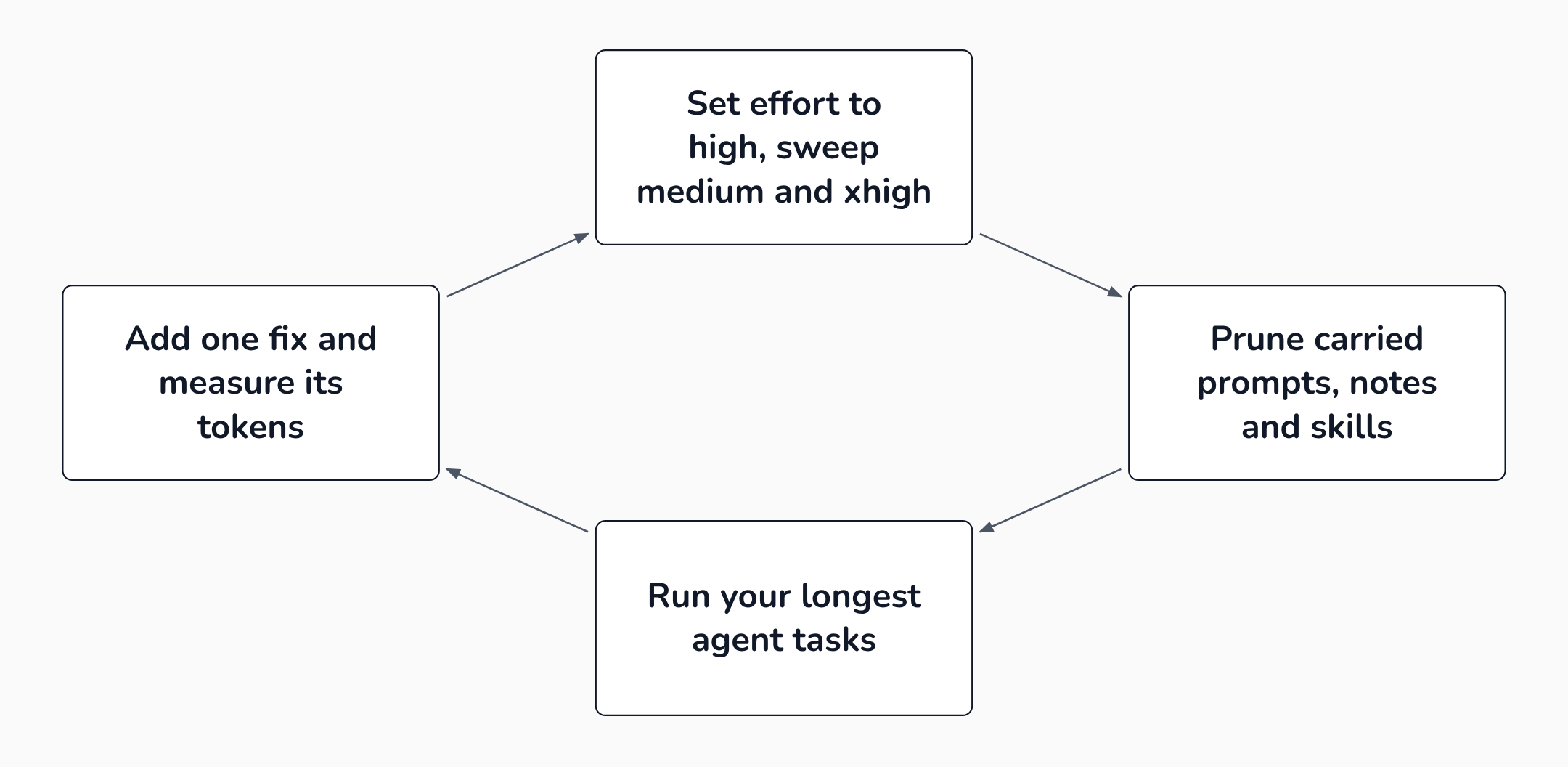 Steps three and four repeat: run the tasks, add one fix for one observed behavior, and measure it before adding the next.
You do not need a formal eval suite to measure step 4.
Each fix has a symptom you can count in an ordinary run log:
- turns that ended with work left
- the longest stretch with no user-facing text
- subagents started per task
- output tokens
Count them before and after one change. Build to Launch's Claude Code token optimization guide covers where those tokens go in Claude Code.
Every measured effect in this guide comes from Anthropic's own tests, two days after release. No independent replication has turned up yet.
Across those tests, the cheapest change on Claude Fable 5.2 is usually a deletion.
FAQ
Does "think step by step" still work on Claude Fable 5.2?
Thinking is always on in Claude Fable 5.2. You cannot turn it off. The model reasons before answering. Asking it to write that reasoning into the reply can be refused under the reasoning_extraction category.
Remove those lines. Set the thinking display to "summarized" if you want to read how it reasoned.
What effort level does Claude Code use for Claude Fable 5.2?
Claude Code uses medium. The Claude API uses high, according to Anthropic's model guide. Run /effort status to check yours.
Should you move from Claude Opus 5.5 to Claude Fable 5.2?
For most coding and knowledge work, Anthropic says to start on Claude Opus 5.5, as the opening notes. Opus 5.5 costs $4 / $20 per million tokens against Fable 5.2's $8 / $40.
On the hardest work the gap can close. On FrontierCode 2.0, Fable 5.2 at high scored 45.3% against Opus 5.5 at max at 45.5%, for roughly half the cost per task.
Test Fable 5.2 before raising Opus 5.5 past high.
Sources
- Anthropic, Prompting Claude Fable 5.2, Claude Platform Docs, accessed 2026-11-11.
- Anthropic, Claude Fable 5.2 overview, Claude Platform Docs, accessed 2026-11-11.
- Addy Osmani, Which Claude model should you build with? Fable, Opus, Sonnet, or Haiku, claude.dev, 2026-11-09.
- Anthropic, Introducing Claude Fable 5.2 and Claude Mythos 5.2, 2026-11-09.
- Hacker News, Claude Fable 5.2 and Mythos 5.2 discussion, 2026-11-09.
- NotesByLex, Fable 5.2 One-Shotted My Nephew's Dream Game, 2026-11-09.
- Build to Launch, What Are Claude Code Subagents? (And How to Make the Most of Them).
- Build to Launch, Claude Code Token Optimization: Full System Guide (2026).
Links
- Prompting Claude Fable 5.2 (documentation)
- Claude Fable 5.2 overview (documentation)
- Which Claude model should you build with? Fable, Opus, Sonnet, or Haiku (documentation)
- Introducing Claude Fable 5.2 and Claude Mythos 5.2 (documentation)
- Claude Fable 5.2 and Mythos 5.2 (Hacker News discussion) (article)
- Fable 5.2 One-Shotted My Nephew's Dream Game (NotesByLex) (article)
- What Are Claude Code Subagents? (And How to Make the Most of Them) (article)
- Claude Code Token Optimization: Full System Guide (2026) (article)
New guides on building with AI come in the Build to Launch newsletter.
More guides
Fable 5.2 vs Opus 5.5: Raise Effort Before You Switch Models
Anthropic says to start on Opus 5.5 and switch models last. Give Claude a check, raise effort one level, then try Fable 5.2, which costs about the same as Opus at max in independent tests, not half.
Vibe Coding Development Services: A €3,000 and a €12,000 Quote Can Buy the Same Screens
The screens in an agency quote are what your AI tool already builds. Compare vibe coding quotes on the five lines a prototype leaves out: data locked to each user, a security review, deployment, code ownership and fixes after handoff.
How to Build Claude Interactive Apps That Still Work When Claude Withholds the New Features
Claude interactive apps are MCP Apps: a tool on your remote MCP server opens a sandboxed web view in the conversation. The inline view reaches every install; the side panel, app tools, entry points and embedded sites added on 2026-11-10 depend on each user's organization, interface and listing, so build them as upgrades.