
Don't Wait for a Cheap Model to Ask for Help: Lock the Planner to Read-Only and Switch Back After Two Failed Tests
A cheap executor model rarely asks a stronger planner for help, so wire the handback outside its judgment: a read-only planner that writes its replan conditions, and a forced switch after a check fails twice.
Anthropic gave Claude Haiku 5.5 and Claude Sonnet 5.5 a stronger model they could consult at any moment, called an advisor. Then it ran both through 198 questions from GPQA Diamond, a graduate-level science test, twice each.
Neither model consulted the advisor on a single question. No system prompt asked them to. None of them chose to.
The help sat there, billed on every request. It went unused.
That result matters to anyone who splits agent work between two models. A strong one, the planner, decides what to do. A cheaper one, the executor, edits files and runs tests.
The split saves money only if the executor hands back the hard moments, and most setups assume it will notice when it is out of its depth.
Short answer. A cheap executor model rarely hands work back to a stronger planner on its own. So a two-model coding loop needs the handback wired outside the executor's judgment. Give the planner no write tools. Have it write the replan conditions. Then force a switch back after a check fails twice. The switch is only as good as that check.
Does a cheaper model ask for help on its own?
Mostly, no.
Anthropic's guide to optimizing for cost and intelligence measured executor and advisor pairs on several workloads. On a chart-reading benchmark, the executor consulted its advisor on 1 of 300 tasks.
The pair scored 7 points below the executor alone.
One pairing did ask often. On Anthropic's internal coding benchmark, it consulted about 1.4 times per attempt. It scored 1.7 points higher than the executor alone, for about 2.1 times the cost. Anthropic places that gain "at the edge of run-to-run noise."
Anthropic's earlier launch post for the advisor strategy told a brighter story about coding. There, Sonnet with an Opus advisor gained 2.7 percentage points on SWE-bench Multilingual, a set of coding tasks, "while reducing cost per agentic task by 11.9%."
So asking can pay. It just has to happen.
Unused help still costs money, too. The tool's definition adds about 1,000 prompt tokens to every request. The guide says it "adds cost even when the executor never consults." On the science questions, where no call was made, that added 12% to Haiku 5.5's cost per question and 25% to Sonnet 5.5's.
Anthropic's summary is blunt: "An advisor can help only when the executor consults it."
Executors rarely ask because of who makes the call. In the advisor strategy, "the executor model decides when to invoke it." Claude Code's advisor documentation says the same about its /advisor command, where the timing "is model-driven rather than rule-based."
So the design leaves the cheap model to judge whether it is stuck, the one judgment a cheaper model is worst placed to make.
Can a better prompt make the executor ask?
Anthropic tried that.
Its advisor tool documentation warns that "without system-prompt steering, the executor tends to under-call the advisor in some domains, particularly coding tasks." It ships a suggested system prompt that tells the executor to call when stuck: "errors recurring, approach not converging, results that don't fit."
The cost guide points executors that rarely consult to system prompts that ask for consultations. Then it reports the test.
"On 20 SWE-bench Pro problems, the suggested prompt made no clear difference for Claude Sonnet 5.5."
Claude Code offers no switch to fall back on either: "There is no setting to cap or force advisor calls."
A prompt leaves the decision with the executor, so it stays a request the executor can pass over. The decision has to move elsewhere.
How Google's Orchestrator moves the decision out of the executor
Google built that move into Orchestrator, a model option in its Antigravity coding agent. Orchestrator launched on November 12. In one session, it pairs a planner with the cheaper Gemini 4 Hydrogen as executor.
The planner is Gemini 4 Carbon, the model Google measured Orchestrator against, or Gemini 4 Argon, or since November 18, Gemini 4 Neon.
Antigravity's model documentation describes the loop in four parts.
Each message "starts with a read-only planning phase in which the planner explores the codebase, resolves ambiguities, and writes a concrete implementation plan, including the conditions that should trigger re-planning." The executor then edits, builds, and runs tests against that plan.
Control comes back on events in the loop, rather than on the executor deciding it needs help. The docs list "a verification step that fails twice, an interface that behaves differently than expected, or a design choice the plan didn't settle."
When one fires, the planner "inspects the conversation state, repairs the plan, and hands execution back to the executor."
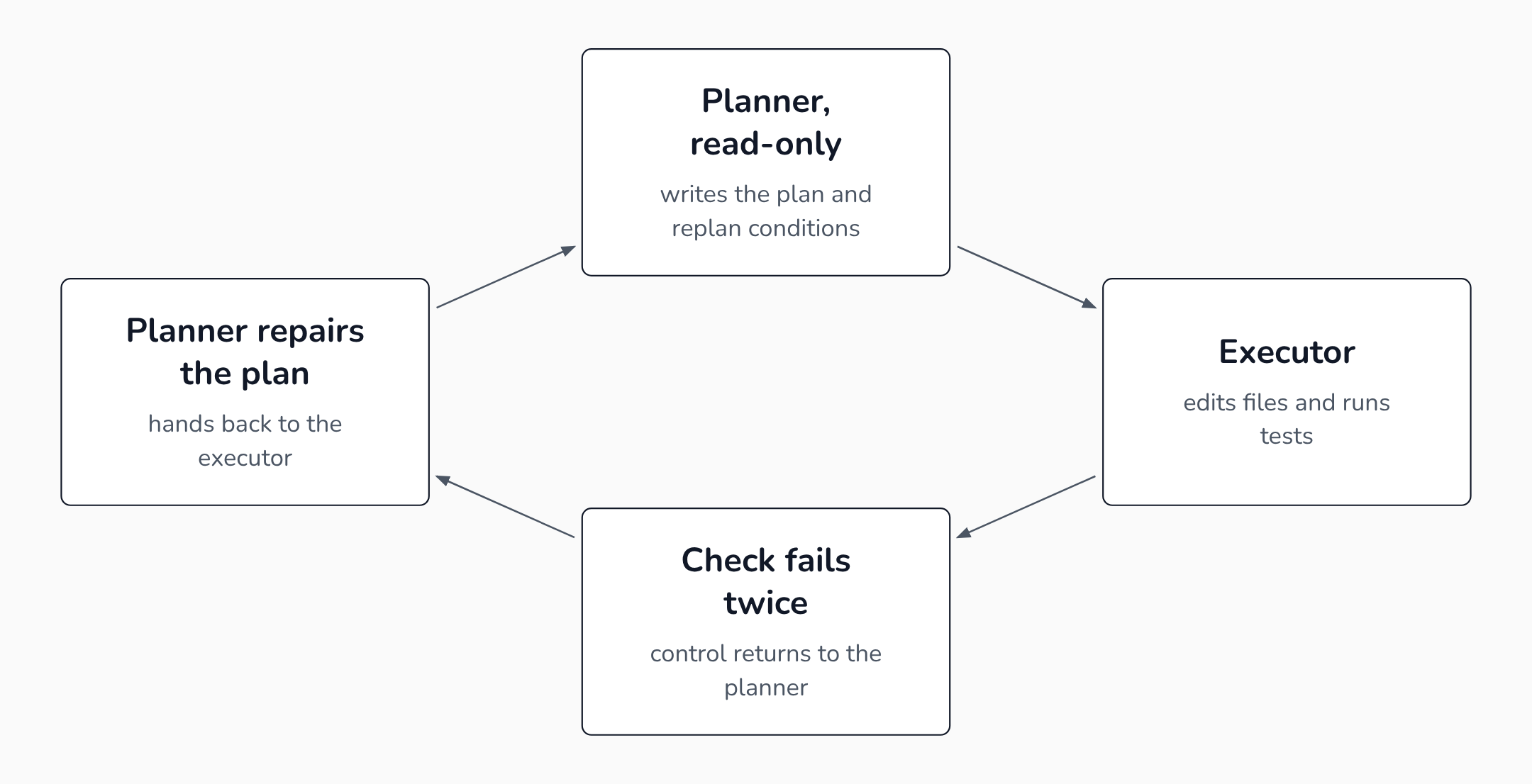 Control returns to the planner on events the loop can see, such as a check failing twice, rather than on the executor's own judgment.
Google also says what Orchestrator is not. "Orchestrator isn't a router that classifies your prompt upfront and sends the whole request to a single model."
Its launch post explains why. How hard a task is often shows up only as the work unfolds. So a router that guesses difficulty from the first prompt starts "breaking down as agents become longer running."
Google ran its own measurement on Terminal-Bench, a coding-agent benchmark. "On Terminal-Bench 4.1, Orchestrator reached near-Carbon task success rates while, on average, consuming 24% less quota and completing 19% faster."
Near-Carbon means close to Carbon running alone.
Four cautions apply:
- The figure is Google's, measured on Google's product.
- Google's model announcement gives the same numbers for Terminal-Bench 4.0.
- No absolute success rate or independent repeat has been published, as one compilation of the docs notes.
- Google published no separate figure for the Neon pairing.
Two of the loop's four parts carry over to any loop: the planner that cannot write, and the switch that fires on a failed check.
Rule one: the planner gets no write tools
In Orchestrator, the planning phase is read-only by design. Writing the replan conditions is part of that phase. The expensive model explores, decides, and writes down when its plan should be reopened.
The cheap model does the editing.
The saving depends on that split. Every edit the planner makes runs at the planner's price. One Antigravity user reported on Google's forum that Argon as orchestrator "handles way too many of the tasks itself" and "runs out of weekly usage before the Gemini pool does."
An independent coding-agent project shows where that limit should live. The OpenDev paper describes a first design that switched the main agent into a restricted planning state with four tools. It "was brittle: the agent sometimes failed to exit plan mode, leaving the system stuck in a read-only state requiring manual intervention." OpenDev's replacement spawns a separate planner. Its tool list contains only read-only tools. "The LLM never sees tool definitions it cannot use, eliminating the possibility of write attempts during planning."
So the limit sits in the list of tools the planner is given, where no instruction can talk it out of the rule.
Rule two: a counter decides when to switch back
The second rule turns "am I stuck?" into a count the loop keeps. After two consecutive failed checks, control goes back to the planner, whatever the executor thinks of its progress.
Of Orchestrator's three triggers, this is the one a loop can detect without asking any model. A test passes or fails. The other two, an interface surprise and an unsettled design choice, still depend on a model noticing them.
Anthropic has measured a related policy on Claude. The policy turns on effort, the setting that controls how much a Claude model reasons before it answers. Anthropic's cost guide recommends running at low effort and re-running failures at high.
"At low, 13% of tasks failed. With those re-run at high, the pass rate was slightly higher than with everything at high, for a little over half the cost."
That policy differs from Orchestrator's in two ways. The same model re-runs the whole task, and it escalates after one failure rather than two.
What the two policies share is the part that matters here: a test fires the escalation, and the model's own opinion plays no part.
Table: Two ways to escalate to more capability, as Anthropic measured them
| Who decides to escalate | Anthropic's measurement | Result |
|---|---|---|
| The executor, by calling an advisor | Science questions: consulted on 0 of 198, in two runs each | Within noise of the executor alone, at 12% to 25% more cost |
| The executor, by calling an advisor | Chart reading: consulted on 1 of 300 tasks | 7 points below the executor alone |
| A failed test, by re-running at higher effort | Low effort first, failures re-run at high | Slightly higher pass rate than all-high, for a little over half the cost |
A failed test fired the escalation that worked; the executor almost never fired its own.
The counter is only as good as the check
Anthropic attaches two conditions to that saving. The first: "you need a failure signal (here, the benchmark's own tests); a checker that passes bad work lets those failures through." The second: "every first-pass failure takes two runs' worth of wall-clock time, so the saving is paid for in latency on the failures."
The first is the dangerous one. A switch that fires on failed tests never fires on code that passes weak tests.
Antigravity users already hit that limit. One bug report on Google's developer forum found that verification subagents launched during execution "silently drop to Hydrogen." "As a result, code authored by Hydrogen during an Orchestrator execution phase ends up being reviewed and stress-tested by Hydrogen as well."
The threshold matters less than the check. The number two is Google's choice. No published source compares switching after one failure with switching after two or three. Anthropic's re-run policy escalates after one.
So treat two as a starting value to tune, and spend the effort on making the check strict enough to fail bad work.
Outside Antigravity, the evidence covers the trigger, not the whole handoff. Anthropic's numbers show test-fired re-runs working on Claude. This research found no published measurement of a planner taking over mid-task on Claude. For an OpenAI planner and executor pair, none turned up either.
Copying the two rules into your own loop
The steps below build the two rules only from the sources above. They apply whether the loop is Claude Code, the Messages API, or a script of your own.
- Give the planning step a read-only tool list. File reads and search only, with no edit, write, or shell tools in its definition, as OpenDev did. Build to Launch's guide to Claude Code subagents covers giving a subagent its own restricted tools.
- Make the plan carry its own exit conditions. Ask the planner for the steps plus the events that should send work back. Turn every condition you can into a check the loop runs, such as a test file or a type check.
- Count consecutive failed checks in the loop's code. At two, stop the executor and hand the planner the failing output, the diff so far, and the original plan.
- Keep an advisor if you already use one, as a bonus. Treat any consultation as extra help, never as the escalation path. The API accepts only some executor and advisor pairs. When it refuses a pairing that Claude Code attached, Claude Code drops the advisor without telling you: "you see no error and get no advisor calls."
The advisor tool definition from Anthropic's April launch post shows why step 3 has to live in your code:
response = client.messages.create(
    model="claude-sonnet-4-6",  # executor
    tools=[
        {
            "type": "advisor_20260301",
            "name": "advisor",
            "model": "claude-opus-4-6",
            "max_uses": 3,
        },
        # ... your other tools
    ],
    messages=[...]
)
max_uses caps calls, but nothing in the definition makes one happen.
The executor model still decides.
What should you measure?
Start with how often the switch fires. Every handback pays for the executor's failed attempts and then for the planner's turn on top.
Anthropic's baseline rule for advisors applies here too: "first price its model alone at low effort," meaning the advisor's model. If most tasks hand back to the planner, the strong model running alone is likely cheaper than the pair.
Next, compare the pass rate with the strong model running alone on the same tasks. Google's near-Carbon claim is that comparison. Only your tasks can settle it.
Then count what each handoff costs in cache. A coding agent "resends the entire growing conversation" every turn, Anthropic's guide explains, and caching makes each resend cost "about a tenth as much."
Switching models can lose that discount.
One user filing an upstream bug report saw cached input tokens drop to 0 at every planner and executor transition. Another found that the planner's research context turned into cache misses after each handoff, and that the handoff "is not necessarily surfaced to the user via the UI."
Log every switch yourself. Then the count is real. Build to Launch's notes on Claude Code token optimization cover where session cost goes.
FAQ
Which plans include Antigravity's Orchestrator?
Google's launch announcement on its developer forum says Orchestrator (Neon) is included on paid Google AI Pro and on Google AI Ultra. Free and Google AI Plus do not include it.
Orchestrator (Carbon) launched for Ultra subscribers. Its thinking level is fixed, so the /effort command does not change it, as one compilation of the docs reports.
Has anyone repeated Google's 24% and 19% figures?
No independent repeat has been published as of 2026-11-25.
The figures come from Google's November 12 post, which does not give an absolute success rate. Google's own posts also disagree on whether the run used Terminal-Bench 4.1 or 4.0.
Can I make Claude Code's advisor fire on a schedule?
No.
Claude Code's advisor docs say "there is no setting to cap or force advisor calls". You can only ask for consultations in your instructions.
A rule that must fire every time belongs in your own loop code.
Sources
- Google Antigravity docs, Models (Orchestrator), read 2026-11-25
- Google Antigravity blog, Gemini 4 Hydrogen and Orchestrator, 2026-11-12
- Google Antigravity blog, Gemini 4 Neon in Google Antigravity, 2026-11-18
- Google, Introducing Gemini 4 Hydrogen, 2026-11-12
- Google AI Developers Forum, Gemini 4 Neon and Orchestrator (Neon) are now available, 2026-11-18
- Anthropic, Optimizing for cost and intelligence, read 2026-11-25
- Anthropic, Advisor tool, read 2026-11-25
- Claude Code docs, Escalate hard decisions with the advisor tool, read 2026-11-25
- Anthropic, The advisor strategy, 2026-04-09
- OpenDev, Building AI Coding Agents for the Terminal, arXiv, 2026-03-05
- Google AI Developers Forum, Orchestrator modes downgrade verification subagents to Hydrogen, 2026-11-21
- Google AI Developers Forum, Orchestrator not eager to dispatch work to subagents, 2026-11-21
- Google AI Developers Forum, Antigravity upstream bug submission pack (v2.32.2), 2026-11-19
- Google AI Developers Forum, Argon as Orchestrator is amazing but, 2026-11-16
- Ahmet Balaman, What Is Antigravity Orchestrator?, updated 2026-11-19
- Build to Launch, Claude Code subagents explained
- Build to Launch, Claude Code token optimization
Links
- Google Antigravity docs: Models (Orchestrator) (documentation)
- Gemini 4 Hydrogen and Orchestrator (Google Antigravity blog) (documentation)
- Gemini 4 Neon in Google Antigravity (Google Antigravity blog) (documentation)
- Introducing Gemini 4 Hydrogen (Google) (documentation)
- Gemini 4 Neon and Orchestrator (Neon) are now available (Google AI Developers Forum) (documentation)
- Optimizing for cost and intelligence (Anthropic) (documentation)
- Advisor tool (Anthropic) (documentation)
- Escalate hard decisions with the advisor tool (Claude Code docs) (documentation)
- The advisor strategy (Anthropic) (documentation)
- Claude Code subagents explained (Build to Launch) (article)
- Claude Code token optimization (Build to Launch) (article)
- Building AI Coding Agents for the Terminal (OpenDev, arXiv) (article)
- Orchestrator modes downgrade verification subagents to Hydrogen (Google AI Developers Forum) (article)
- Orchestrator not eager to dispatch work to subagents (Google AI Developers Forum) (article)
- Antigravity upstream bug submission pack v2.32.2 (Google AI Developers Forum) (article)
- Argon as Orchestrator is amazing but (Google AI Developers Forum) (article)
- What Is Antigravity Orchestrator? (Ahmet Balaman) (article)
Every Friday: what builders launched this week, and one guide to help you ship yours.
More guides
An AI Rewrite Passed 98% of Its Tests and Matched a Quarter of Real Requests: Verify Yours Against Recorded Inputs
Before a coding agent ports working code, record what the old code does on real inputs, lock that recording where the agent can't edit it, and call the port done only when the new code matches it. Anthropic's Rust rewrite shows why green tests are not enough.
Improve AI Agent Accuracy With Notes From Its Wrong Answers: Docs Scored 36%, Four Notes 76%
On 42 held-out questions, a Claude Haiku 5.5 data agent scored 36% with its company's docs and 76% with four short notes written from its own wrong answers. Write one rule per kind of mistake, and keep it only if it helps on questions it never saw.
Did Claude Code Get Worse? Read Your Session Logs Before You Turn Effort to Max
Your Claude Code session logs show whether your setup changed and whether the model is skipping work or ignoring work it already did. Higher effort fits only the first.